Chatbot or voice agent: which one does your business really need
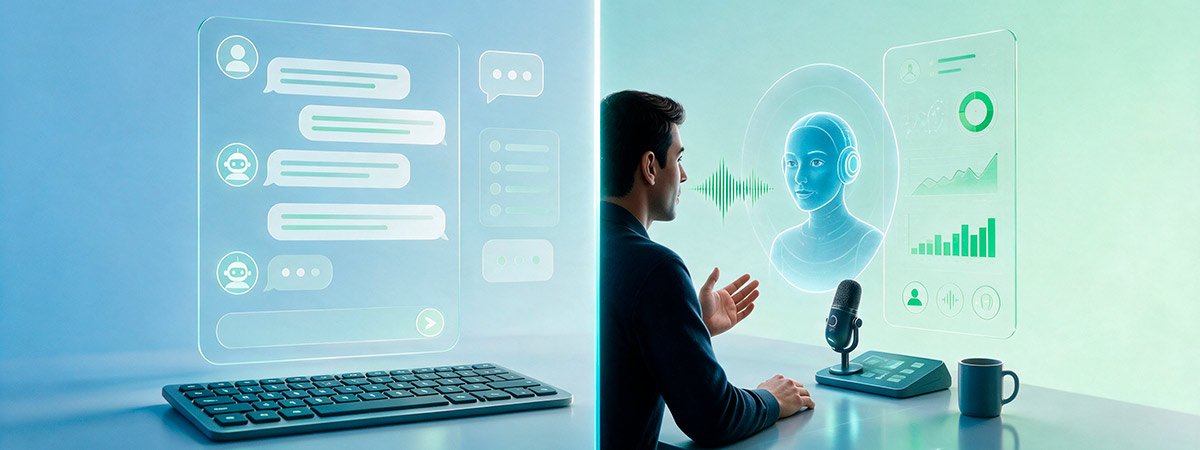
Before automating customer service, you need to settle a question that looks technical and is really a business one: how do your customers reach you? If they reach you by writing, you need a chatbot. If they reach you by calling, you need an AI voice agent. Automating the wrong channel is the most expensive way to solve nothing, and it happens more than it seems because almost every provider pushes the product they sell, not the one you need.
The real difference isn’t the technology, it’s the channel
Under the hood they’re quite similar: both understand natural language, both look up your data, and both can leave an appointment booked. The difference is in the behavior of the person on the other end.
Someone who writes is willing to wait. They send the message, put the phone down, and come back in ten minutes. Someone who calls isn’t: they want an answer now, and their patience is measured in seconds. That distinction shapes everything else.
| Chatbot (WhatsApp, web) | Voice agent | |
|---|---|---|
| Response expectation | Minutes | Immediate |
| Margin for error | High: it can be rephrased | Low: if it fails, they hang up |
| Leaves a written record | Yes, by default | Yes, via transcription |
| Works for sending links, photos, forms | Yes | No |
| Works while driving or with hands busy | No | Yes |
| Customer profile that prefers it | Under 45, urban | Senior customers, trades, emergencies |
| Cost per interaction | Lower | Higher |
| Can be picked up again later | Yes, the conversation stays open | No, the call starts and ends |

When you need a voice agent
The clearest signal is in your own data: if you have missed calls, you need voice. A chatbot won’t recover a single one of them, because someone who calls and doesn’t get an answer doesn’t go to your website to write. They call the next number on the list.
A voice agent fits when:
- The phone is your main inbound channel, even if you have WhatsApp set up.
- You accumulate missed calls in specific time slots, usually first thing in the morning or at midday.
- Your customer has a real emergency: a breakdown, a toothache, a car that won’t start.
- A good share of the calls are repeat questions that don’t need anyone with judgment.
- Your customer is a senior or from a trade where calling is still the norm.
When you need a chatbot
The AI agent for chat channels fits when:
- You get more WhatsApp messages than calls, and they arrive at all hours.
- The conversation requires sending things: catalogs, photos, quotes, payment links.
- The decision process is long and the customer returns to the same conversation several times.
- You sell online and the questions are about orders, shipping, and returns.
- Your team loses track of who answered what because everyone replies from their own mobile.
The case nobody talks about: both, but not at the same time
For quite a few SMEs the honest answer is “both.” But rolling them out at the same time is an expensive mistake: you multiply the points of failure just when you have the least judgment to spot them.
The right order is set by pain, not budget. Start with the channel where you’re losing money today. If the phone rings and nobody picks up, start with voice even if chat is cheaper. If WhatsApp is piling up messages left unanswered since the night before last, start with chat even if voice looks more modern.
Once the first one has been running for a couple of months and has been reviewed, add the second. And then it does matter that they share information: that the customer who wrote yesterday doesn’t have to explain everything again if they call today.
Three mistakes that cost you
Putting in a chatbot because it’s cheaper when your problem is calls. It’s the most common one. Chat doesn’t reduce missed calls: at most it diverts the portion of customers who were already willing to write. The rest keep calling and keep getting no answer.
Putting in voice at a business with low phone volume. If you get eight calls a day, good call forwarding and well-configured schedules solve almost the same thing for far less money.
Measuring the result by savings and not by what comes in. The right question isn’t “how many calls has the AI handled,” it’s “how many opportunities have we recovered that used to be lost.” They’re very different numbers, and only the second one justifies the investment.
How to decide with your own data in ten minutes
Pull four figures from the last month: calls received, calls missed, WhatsApp messages received, and messages answered with more than an hour’s delay.
Wherever the “unattended” percentage is higher, that’s your channel. It’s no more complicated than that, and it’s infinitely more reliable than any demo.
If you don’t have that data on hand (which is typical when the team calls from separate mobiles), at Glofera we pull it for you in the free communications analysis. We tell you which channel is bleeding and what makes sense to automate first. And if the answer is “none yet,” we’ll tell you that too.
Frequently asked questions
What’s the difference between a chatbot and an AI voice agent?
The channel and, with it, the customer’s expectation. A chatbot handles written conversations that allow waiting and let you send links or files. A voice agent handles calls, where the response has to be immediate and the margin for error is much smaller because the customer hangs up.
Can a chatbot reduce my missed calls?
Only indirectly and to a limited extent. Someone who calls and gets no answer rarely switches channel: they call the next supplier. To recover missed calls, you need to cover the voice channel.
Can you have both connected?
Yes, and it’s the ideal scenario when both channels have volume. It’s best to roll them out separately, starting with the one losing the most opportunities, and connect them afterward so the customer doesn’t have to repeat their case when switching channels.
Which one is cheaper?
Chat, per interaction. But the relevant cost isn’t that of the interaction, it’s that of the lost opportunity: an unanswered call at an emergency business costs far more than any difference in rates.
What about customers who don’t want to talk to a machine?
On both channels there should be a clear exit to a person, offered from the start. In addition, European regulations require you to disclose that an automated system is answering.
Related Posts