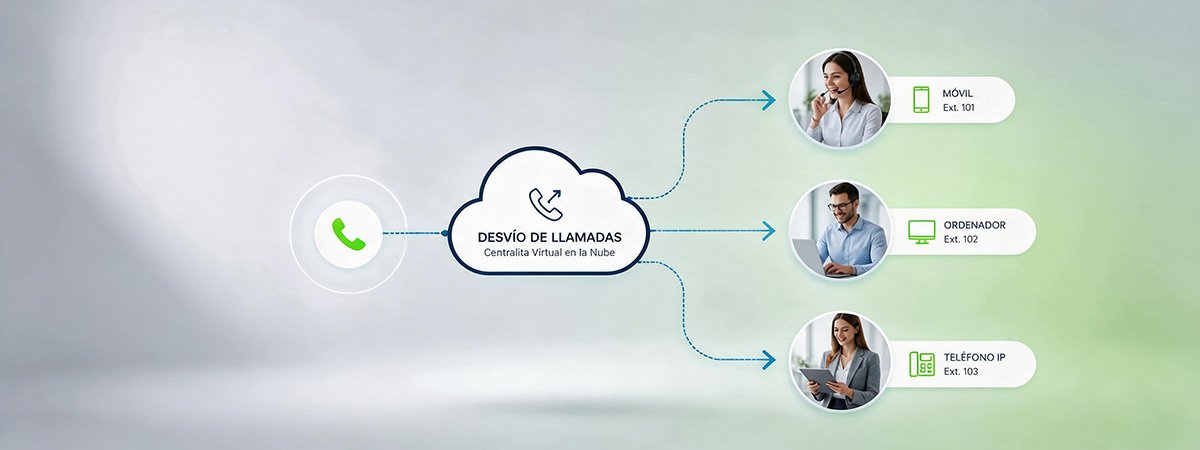
Call forwarding for businesses: complete 2026 guide
Call forwarding is the oldest feature in any PBX and the worst used one. Almost every SME has exactly one configured — “if I don’t pick up, to the boss’s mobile” — and thinks that settles the matter. It doesn’t: what they have is a bottleneck with a name and surname.
This guide walks through the six types of call forwarding that exist, when each one applies, and the mistakes that make a badly set up forward worse than having none at all.
The six types of forwarding and what each one is for
1. Unconditional forwarding
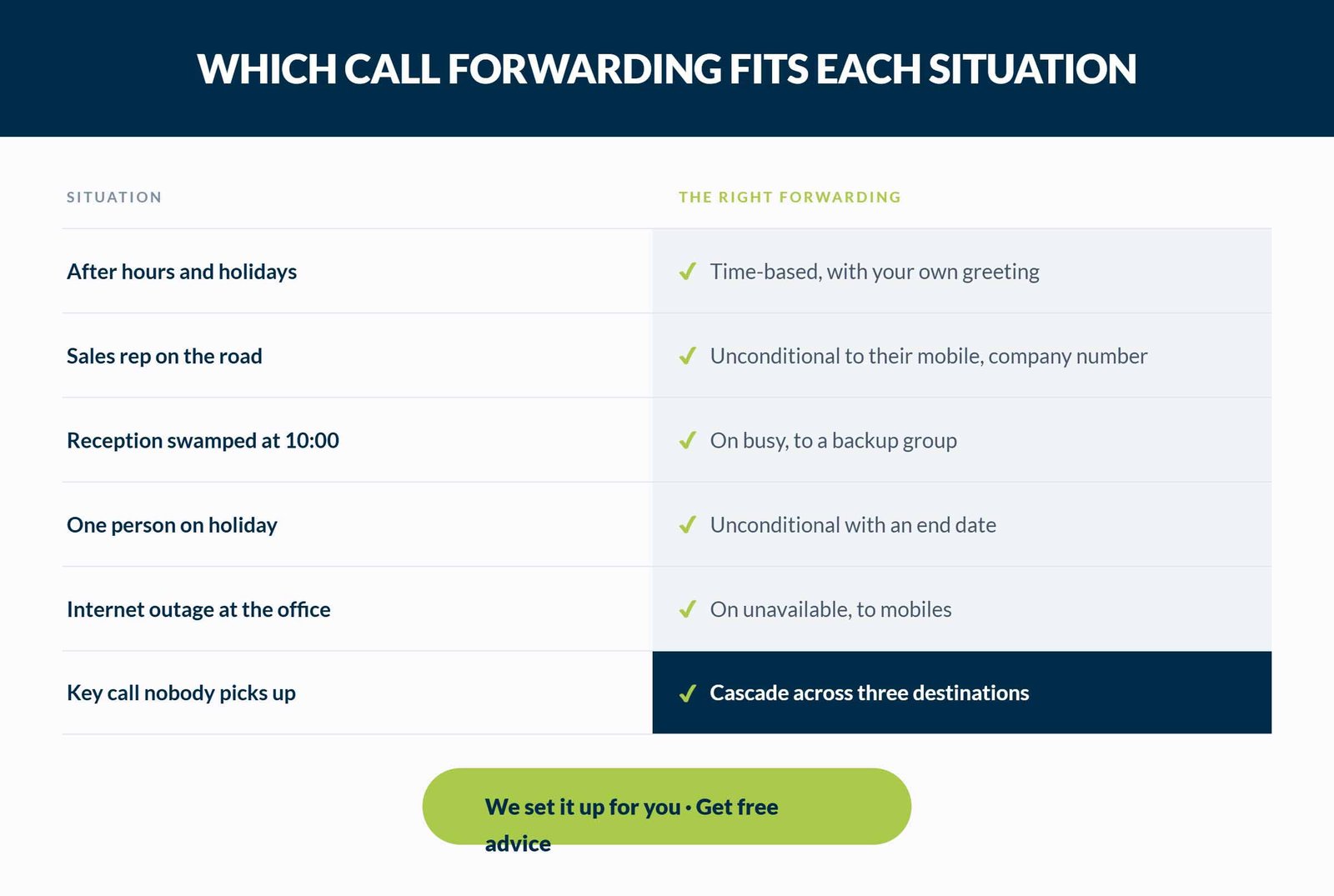
Every call goes straight to another number without the original ever ringing. It’s used for closed situations: an office closed for renovations, a vacant position, an old number you want to keep alive while you announce the change.
The common mistake: leaving it set up and forgetting about it. It’s the number-one cause of calls going to a mobile that no longer works at the company.
2. No-answer forwarding
The main destination rings and, after X seconds, it jumps to the next one. The parameter that matters is timing: under 15 seconds gives nobody enough time to pick up; over 25 the customer has already hung up.
What we recommend: between 18 and 20 seconds, about four or five rings.
3. Busy forwarding
When the extension is on another call. There’s a business decision disguised as a technical setting here: would you rather the customer wait in a queue hearing that they’ll be attended shortly, or jump immediately to another colleague? For urgent matters — a breakdown, a medical appointment — jump. For sales inquiries, queue.
4. Unavailable forwarding
Kicks in when the device isn’t registered: mobile with no signal, softphone closed, phone unplugged. It’s the forward that saves the day when the power goes out at the office and nobody’s noticed yet.
5. Schedule-based forwarding
Doesn’t depend on whether someone picks up the phone — it depends on the clock and the calendar. After hours, holidays, Friday afternoon in August. Without it, calls at 9pm ring into an empty office and get logged as missed with nobody able to do anything about it.
This is where a well-written greeting makes all the difference. We have ready-to-adapt greeting examples.
6. Cascading forwarding or ring group
More than a forward, it’s a sequence: it rings at reception, if unanswered it rings in administration, then the manager’s mobile, and if nobody picks up, it goes to an AI voice agent or voicemail. This is the setup that actually plugs the missed-call gap — and the one almost nobody has in place.
The last link decides whether you recover the call or lose it. Four options, from worst to best: On a cloud-based virtual PBX, forwarding can be changed from a web panel in under a minute, with no technician and no call to the operator. That’s what lets you adapt the setup to the reality of the business: trade fair week, a long weekend, an unexpected sick day for the receptionist. If your current PBX requires you to open a ticket just to change a schedule, you don’t have a forwarding problem. You have one of the clear signs you need to switch PBX providers. It depends on the provider. Many business plans include forwarding to national mobiles in the flat rate; others bill it as an outbound call. It’s worth asking before signing, because at high volume the difference adds up. Yes. You can route by caller ID: have your three main clients go straight to the salesperson who manages their account, and route everyone else through reception. It shouldn’t. Set up properly, the mobile shows the caller’s number, not the PBX’s, so you know who you’re talking to before you pick up. Most forwarding setups we come across were put in place once, years ago, for a team that no longer exists. We analyze how your calls are routed today for free and tell you what to change, with no obligation.Quick decision table
Four mistakes that cost you customers
What to put at the end of the chain
How to set it up without depending on anyone
Quick questions about call forwarding
Does forwarding to mobile cost extra per call?
Can I have different forwarding rules depending on who’s calling?
Does the customer’s caller ID get lost when a call is forwarded?
Let’s review your call chain

Related Posts