Business number: how to get one without a physical landline
Having your company show up on a customer’s mobile with a number starting with 6 that says nothing about you has a cost. It doesn’t show up on any invoice, but it’s there: calls that don’t get returned, customers who don’t save you to their contacts, and a business image smaller than what you actually are.
The good news is that having a business number no longer requires a copper line, a fixed office, or a two-year contract. Here’s what you need to know to choose well.
What a business number actually is today
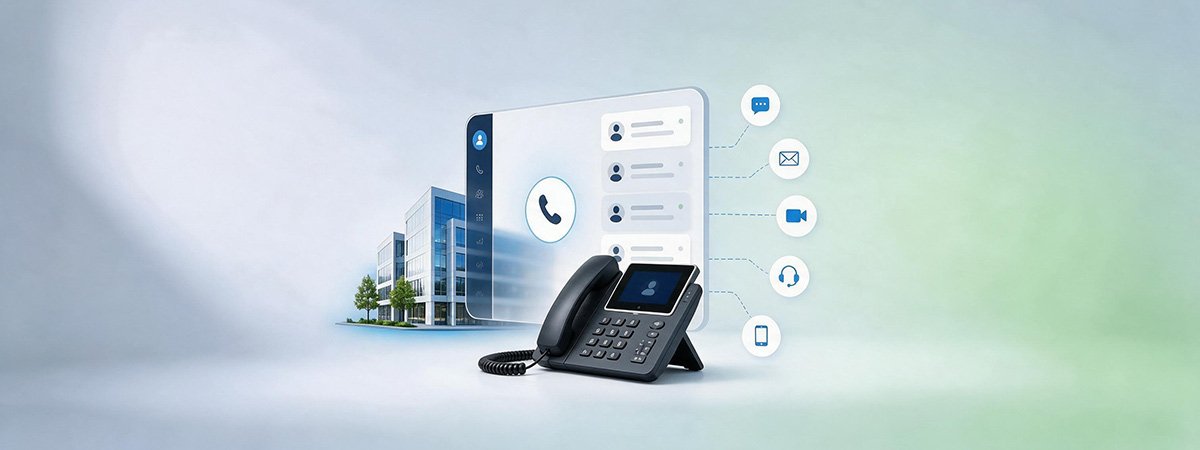
It’s a number assigned to your business, not to a device or a location. That’s the difference from a traditional landline: the number used to live at a physical point, and whoever wasn’t in front of the phone didn’t exist. Now the number lives on the PBX, and the PBX decides which device it rings on: a desktop phone, a computer, or the mobile of anyone on your team.
Practical consequence: you can have a business number without having an office, and you can have fifteen people answering the same number from fifteen different locations.
The classic. It conveys local roots and works best for businesses that sell in their own area: clinics, accounting firms, garages, real estate agencies. A customer in Barcelona trusts a 93 more than a faceless national number. You can have several area codes even if you only have one office. If you sell in Madrid and in Valencia, having a 91 and a 96 both entering the same PBX gives you a presence in both markets. You pay for the call. Makes sense when you want to remove every excuse for a customer not to get in touch: after-sales support, general support, incident handling. It increases call volume, so it’s worth having someone lined up to answer before you publish it. 800 works like 900 in practice. 902, on the other hand, is a number with a cost to the caller that has been dragging a bad reputation for years due to poor customer service; today it does more harm than good. If you still have a 902 published, that’s a change with an immediate return. If your company makes outbound sales calls to individuals, regulations require you to identify yourself with a number in the 400 range. It’s not optional and it affects how your telephony is set up. We cover it in full in sales calls and the 400 prefix, and the general framework is in Order TDF/149/2025. You don’t have to pick just one. The most common setup among the companies we work with: And a rule that saves a lot of headaches: a single public number. Publishing four different numbers in four different places guarantees that one day one of them will stop being answered, and nobody will notice for months. If you already have a number, there’s no need to change it. Portability is a right, the paperwork is handled by the new provider, and the service cutover, if well coordinated, takes minutes. Three things that are worth keeping an eye on: This is where the real shift happens. With a cloud-based PBX, your team calls using the company’s number from their own mobile. The customer sees the 93; the salesperson uses their usual phone. That solves three problems at once: the salesperson doesn’t hand out their personal number, the company keeps the contact when that person leaves, and every call gets logged with statistics and recording. We go into this in how to work remotely without losing your business phone number. And it explains why so many sales calls go unanswered: if you call from an unknown mobile, the customer doesn’t pick up. We analyze this in why customers don’t pick up the phone. Nothing physical. An internet connection, a virtual PBX that manages your numbering and the devices your team already uses. Setting up a new number is a matter of hours; porting one takes a few business days. The part that actually takes time is the one nobody thinks about: deciding what happens when that number rings. Who picks it up first, what happens at 7pm, who answers when the receptionist is on another call. The number is the wrapper; the routing is the product. Yes. Geographic numbering is assigned by province and doesn’t require you to have an address there. It’s common practice for companies wanting a presence in several markets. Nothing. Since it’s not tied to a physical installation, the number keeps working and rings wherever you decide. It’s the strongest argument for not depending on a traditional landline. Yes. Business calls come in and go out through the PBX app, and personal ones through the mobile line. Two identities, one device, and outside business hours the work phone stays quiet. We analyze how your calls come in today, for free, and which numbering suits you based on your market and applicable regulations. No obligation, and no need to switch providers just to hear it.Which numbering suits you
Geographic number (91, 93, 96, 95…)
900 number (free for the caller)
800 and 902 numbers
400 prefix: mandatory for sales calls
The combination that works for an SME
Portability: you keep the number you already have
The number on the team’s mobile
What you need to get it up and running
Quick questions about business numbers
Can I have a Madrid number without an office in Madrid?
What happens to my number if I close the office?
Can I keep the business number separate from my personal one on the same mobile?
Before you set up a number, decide the routing

Related Posts